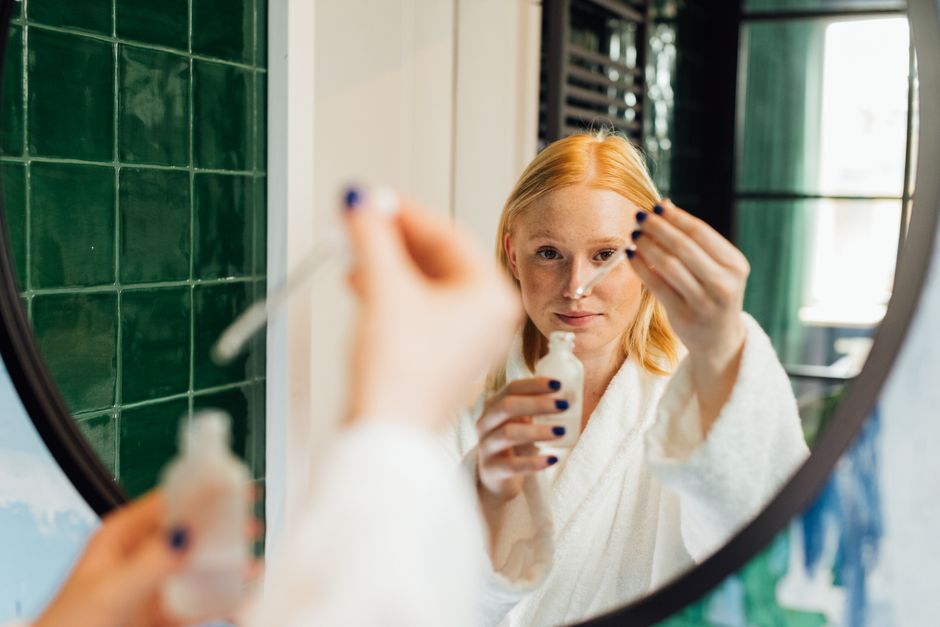
You’re standing in the bathroom at 7:30 AM. You have exactly six minutes to get sunscreen and makeup on before you run out the door. Do you grab the tinted sunscreen in one step, or do you layer your regular foundation with SPF on top of a separate sunscreen?
This isn’t a small decision. It’s the difference between actually being protected from UV damage and just feeling like you are. And most people get it wrong.
The SPF in Your Foundation Is a Lie (Mostly)
Here’s what nobody tells you: the SPF 15 or SPF 20 listed on your foundation bottle was tested in a lab at a very specific thickness. 2 milligrams per square centimeter of skin. That’s the amount sunscreen companies use to get their SPF rating.
Now think about how much foundation you actually apply. A thin layer. Maybe a pump and a half. You’re getting maybe 25% of the labeled SPF on your face. That SPF 20 becomes SPF 5. Maybe.
Compare that to a dedicated sunscreen. You apply a full quarter-teaspoon to your face. The SPF rating on the bottle is real. A tinted sunscreen with SPF 50 means you’re getting SPF 50 — because you’re applying the same amount you would with regular sunscreen.
The La Roche-Posay Anthelios Mineral Tinted Sunscreen SPF 50 ($36 for 1.7 oz) is a good example. It’s a sunscreen first, tint second. The SPF is the point. With most foundations, the SPF is an afterthought.
The “Layering” Problem
Some people think: apply sunscreen, then foundation with SPF on top. Double protection, right? Wrong. Layering SPF products doesn’t add the numbers. SPF 30 + SPF 20 doesn’t equal SPF 50. It equals SPF 30 at best, because the top layer blocks some of the bottom layer. You’re just wasting product.
What Actually Happens to Your Skin Over Time
Let’s talk about the long game. UV damage is cumulative. Every day you wear insufficient protection, you’re adding to the damage pile. Wrinkles, hyperpigmentation, collagen breakdown — these don’t happen overnight. They happen over years of half-assed sun protection.
I’ve seen women in their 40s who used foundation with SPF 15 every day for a decade. Their skin looks older than women who used proper sunscreen. Not because the foundation was bad. Because the protection wasn’t there.
A tinted sunscreen like the Supergoop! Glowscreen SPF 40 ($38 for 1.7 oz) gives you real UV filters at the correct concentration. Plus a tint that evens out skin tone. You don’t have to choose between protection and looking good.
Comparison: Tinted Sunscreen vs Foundation with SPF
| Factor | Tinted Sunscreen | Foundation with SPF |
|---|---|---|
| Actual SPF protection | Full (SPF 30-50 as labeled) | Partial (25-50% of labeled SPF) |
| Application amount needed | 1/4 teaspoon (standard sunscreen amount) | Much less (thin makeup layer) |
| Coverage | Sheer to light | Light to full |
| Reapplication ease | Easy (just add more) | Difficult (messes up makeup) |
| Best for | Daily wear, low-maintenance routine | Events, full glam days |
| Price range | $15 – $45 | $10 – $60 |
The numbers don’t lie. Tinted sunscreen wins for actual protection every single time.
When Foundation with SPF Actually Makes Sense

I’m not saying throw away all your foundation. There are two scenarios where foundation with SPF is fine.
Scenario 1: You’re already wearing proper sunscreen underneath. If you apply a full layer of SPF 50 sunscreen, then top it with foundation that also has SPF, the foundation’s SPF is irrelevant. You’re already protected. The foundation is just for coverage. Fine.
Scenario 2: You’re indoors all day and it’s winter. If you’re in an office with no windows, leaving after dark, and it’s December in a northern climate, your UV exposure is minimal. Foundation with SPF 20 is probably enough. But don’t make it your summer routine.
The IT Cosmetics Your Skin But Better CC+ Cream with SPF 50 ($45 for 1.08 oz) blurs this line. It’s technically a CC cream, but it has enough pigment to work as foundation. And it actually has SPF 50 that you can apply in a thick enough layer. This is one of the few products that works as both. But you still need to apply the full quarter-teaspoon amount — most people don’t.
The Reapplication Problem Nobody Talks About
Sunscreen stops working after two hours. This is not negotiable. The UV filters degrade, you sweat it off, it rubs off on your clothes. After two hours, you need to reapply.
Now tell me: how do you reapply foundation with SPF at 2 PM without looking like a cakey mess? You can’t. You’d need to remove all your makeup, reapply foundation, re-blend. Nobody does that.
With tinted sunscreen, reapplication is simple. You dab a bit more on. It blends in. You look slightly more tinted, but it’s fine. Or you use a powder sunscreen over it. The Colorescience Sunforgettable Total Protection Brush-On Shield SPF 50 ($65 for 0.21 oz) is a powder that goes over makeup easily.
If you can’t reapply, you’re not protected for more than two hours. Foundation with SPF fails this test completely.
Your Skin Type Changes the Answer

Here’s where it gets specific.
Oily skin: Tinted sunscreens can feel greasy. Look for matte formulas like the EltaMD UV Clear Tinted SPF 46 ($43 for 1.7 oz). It has niacinamide to control oil. Foundation with SPF might sit better on oily skin, but you still need real sunscreen underneath.
Dry skin: Tinted sunscreens are often hydrating. The Drunk Elephant Umbra Tinte Physical Daily Defense SPF 30 ($36 for 1.7 oz) has a creamy texture that works well. Foundation with SPF can cling to dry patches. Tinted sunscreen wins here.
Dark skin tones: This is where most tinted sunscreens fail. They leave a gray or white cast. The Black Girl Sunscreen SPF 30 Tinted ($19 for 3 oz) is formulated specifically for melanin-rich skin. Foundation with SPF usually matches better, but again — you need real sunscreen underneath.
The bottom line: if you have a skin tone that tinted sunscreens actually match, use them. If not, use a clear sunscreen under your foundation. Do not rely on foundation SPF alone.