Most hotel gyms have three aging treadmills, a cable machine missing a pin, and fluorescent lighting that makes everyone look unwell. Skipping them is not settling — for many travelers, training outside is the stronger physiological choice.
Why Outdoor Training Often Outperforms Indoor Exercise
Uncontrolled terrain builds better all-around fitness than controlled machines. This is not preference — it is mechanics. On a treadmill, the belt pulls your foot back for you, reducing glute activation by roughly 30% compared to overground running. On a trail, you do all the work. On a flat gym floor, every push-up rep is identical. On grass or packed dirt, your hands sink slightly, your core fires harder to compensate, and stabilizer muscles that go dormant on machines are constantly recruited.
The adaptation demand outdoors is consistently higher than equivalent machine-based movement at the same perceived effort level.
What Uneven Terrain Does to Calorie Burn
A 155-pound person burns approximately 600 calories per hour running at 6 mph on a flat treadmill. That same person on a moderate trail with 300–500 feet of elevation change per mile burns 700–800 calories per hour — at an effort that often feels lower, because varied scenery reduces rate of perceived exertion (RPE) by 10–20% according to multiple peer-reviewed studies on nature-based exercise.
Hill running adds significant eccentric load on the quadriceps during descents. Eccentric loading is the same mechanical stimulus behind heavy barbell squats. You get resistance training benefit from terrain at zero additional cost in setup or equipment.
Surfaces matter too. Grass and packed dirt absorb impact better than concrete — ground reaction forces on grass run roughly 15% lower than asphalt at equivalent speeds. For runners with a history of shin splints or stress fractures, this is not a minor detail.
The Mental Benefit With Measurable Data Behind It
Stanford researchers published findings in 2015 showing that 90 minutes of walking in natural settings decreased activity in the subgenual prefrontal cortex — the brain region tied to rumination — significantly more than equivalent urban walking. Gym sessions do not replicate this effect. Noise-canceling headphones help mask a bad environment; they do not change it.
For travelers managing jet lag and schedule disruption, the cortisol-lowering effect of outdoor exercise has direct performance implications. You recover faster. Sleep quality improves. Those compound over a trip.
When Outdoor Training Is the Wrong Call
Three conditions justify switching to a hotel gym: heat index above 103°F (39°C) with humidity above 60%, air quality index (AQI) over 150, and genuinely dangerous surfaces such as sheet ice or flood runoff. Outside those conditions, most objections to outdoor training are logistical, not physiological. They are solvable with 10 minutes of planning the night before.
The 4 Outdoor Exercises — Compared With Real Numbers
These four exercises cover the full range of fitness demands: cardiovascular endurance, functional strength, low-impact aerobic base, and active recovery. Calorie estimates below are for a 155-pound (70 kg) person.
| Exercise | Calories/Hour (est.) | Equipment Needed | Primary Benefit | Best Fitness Level |
|---|---|---|---|---|
| Trail Running | 650–800 | Trail or road shoes | Cardio + leg strength + proprioception | Intermediate–Advanced |
| Bodyweight Calisthenics | 380–500 | None required | Functional strength + muscle endurance | All levels |
| Outdoor Cycling | 500–700 | Bike (rental works) | Low-impact cardio + lower body endurance | All levels |
| Outdoor Yoga / Mobility | 180–280 | Mat optional | Flexibility + stress reduction + recovery | All levels, ideal on rest days |
Trail Running: The Highest Fitness Return Per Hour
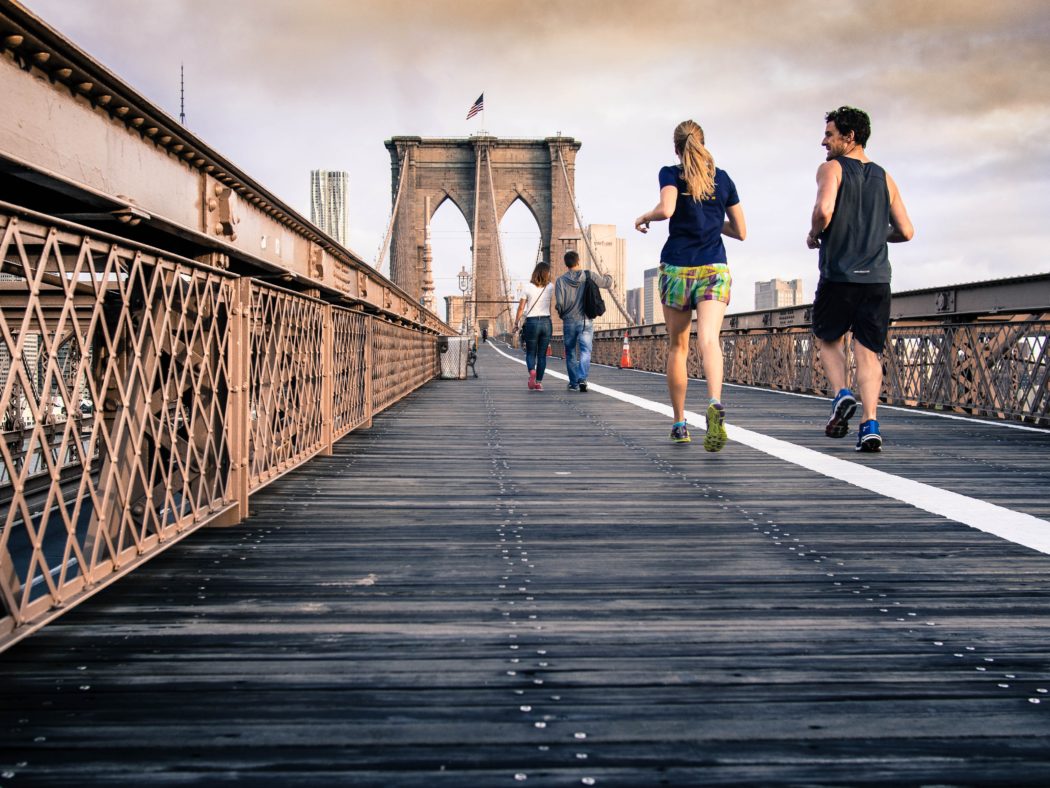
Trail running is the most effective outdoor exercise for travelers with a baseline cardio fitness level who want maximum output per training hour. The combination of cardiovascular demand, balance challenge, and terrain-driven resistance means multiple physical capacities develop simultaneously — a rare efficiency in training.
Shoe selection matters more on trails than most other variables. The Brooks Ghost 16 ($140) handles light trails and packed dirt with enough grip for most recreational runners while remaining comfortable on pavement — the practical choice when you are packing one pair of shoes. If you are running technical trails with loose rock or wet conditions, the HOKA Speedgoat 6 ($145) with its 5mm Vibram Megagrip outsole handles wet rock where the Ghost slips. For a traveler with one bag: Ghost 16. For a trip built entirely around technical trail running with a dedicated second pair: Speedgoat 6.
Start your first trail run at 70–75% of your usual road pace. Terrain adds workload that does not show up in pace metrics, and that invisible load is exactly where overconfident runners roll an ankle on day two of a trip.
Practical tip: Run trails between 6:00 and 9:00 AM when your schedule allows. Temperature is typically 10–15°F lower than midday peak, UV index is manageable, and trail visibility is better. Varied terrain demands more depth perception than flat pavement — lighting conditions matter more than most runners expect.
Bodyweight Calisthenics: The Zero-Logistics Option
A park bench, a horizontal bar (found in nearly every public park globally), and 40 minutes gives you a complete full-body session. Push-ups, pull-ups, Bulgarian split squats with the rear foot on the bench, and plank-to-pike variations hit chest, back, legs, and core with no purchased equipment required.
The most underused outdoor movement is the parallel bar dip. Park railings regularly provide the correct width. Three sets of 15 bodyweight dips produce comparable tricep and chest stimulus to 3×10 weighted dips for most people under 180 pounds — you are using your own mass as resistance.
Carry a set of Perform Better Mini Bands ($18 for five resistance levels, 150 grams total, packs flat) and you immediately gain banded glute bridges, lateral band walks, and shoulder external rotation drills. Hip stability and rotator cuff activation are the two most commonly lost fitness qualities during travel. The mini bands solve both in a 150-gram package.
Practical tip: Progress calisthenics by increasing range of motion before adding volume. A deep push-up with chest touching the ground every rep is harder and more productive than a shallow push-up with 10 extra reps. Most travelers add reps when they should be improving range first — this is the primary reason bodyweight training stops feeling challenging within two weeks.
Gear Worth Carrying vs. What Gets Left in the Hotel Drawer
Travel fitness gear earns its spot in the bag by being lightweight, multi-use, and genuinely non-substitutable. Most specialty fitness equipment fails at least one of these criteria.
- Brooks Ghost 16 ($140): Road-trail versatility without the weight penalty of a dedicated trail shoe. Runs approximately 60–70 miles before midsole compression becomes perceptible. Holds up for two-to-three week trips with daily use.
- Manduka PRO Lite ($98, 4.7mm, 1.7 lbs): The thinnest mat that still provides adequate wrist protection on hard surfaces. Folds to roughly 12×5 inches. The Liforme Travel Mat ($130) is lighter at 2mm but noticeably less cushioned on concrete. Worth it only for standing-pose-focused practices. For any floor work: PRO Lite wins.
- Perform Better Mini Bands ($18/set of 5): Pack these regardless of your primary workout style. They address the hip mobility deficit that accumulates after long flights and sedentary conference days.
- Garmin Forerunner 165 ($249): GPS routing with 11-day battery life, continuous heart rate, and route replay. The practical win is navigation — you can run unfamiliar city streets or trail systems without cell service and find your way back accurately. Calorie tracking runs within 10–15% of lab-measured values, versus 20–30% error on most phone GPS apps.
Skip the jump rope (tangles fast, wears out on asphalt), long resistance tubes with handles (bulkier than mini bands, no functional advantage), and foam rollers. A lacrosse ball at $8 and 2.5 ounces handles 80% of the same myofascial release work in a fraction of the space. These three items are the most common gear abandoned mid-trip.
Practical tip: Carry 500ml of water minimum per 30 minutes of outdoor activity in temperatures above 75°F (24°C). Direct sun exposure accelerates fluid loss faster than indoor training at equivalent intensity — this catches travelers off guard on the first warm-weather workout of a trip.
The Pre-Workout Step That Prevents Most Outdoor Injuries
Cold muscles on uneven terrain fail in predictable ways: hamstring strains on the first hard uphill, calf tears on unexpected foot placement, shoulder impingement on the first set of pull-ups after a 10-hour flight. Five minutes of dynamic warmup — leg swings, hip circles, arm rotations, and 90 seconds of light jogging — reduces soft tissue injury risk by 30–50% in recreational athletes, according to sports medicine research on warmup protocol compliance versus cold starts.
This five minutes is the highest-leverage window in any outdoor session. Skipping it is the most common and most avoidable mistake traveling athletes make.
Outdoor Training Questions With Direct Answers
Can I Actually Build Muscle With Outdoor Bodyweight Training?
Yes — with an honest ceiling. Bodyweight training builds muscle reliably for the first 12–18 months of consistent training. Progressive overload works through harder movement variations: push-up progressions toward one-arm push-ups, pull-up progressions toward muscle-ups, squat progressions toward pistol squats. These are real resistance increases, not just higher reps of the same movement.
For experienced lifters — two or more years of consistent resistance training — outdoor calisthenics maintains existing muscle more reliably than it builds new mass. On a two-week trip, that is not a meaningful limitation. On a three-month relocation, add a local gym session once or twice per week for loaded compound lifts. Calisthenics handles the other days.
How Long Should an Outdoor Workout Actually Be?
Thirty to sixty minutes covers most fitness goals. Below 30 minutes, warmup and cooldown consume too large a proportion of the training window. Above 75 minutes, volume increases without proportional benefit unless training specifically for an endurance event.
Specific targets: trail runs at 65–75% max heart rate for 40–50 minutes; calisthenics circuits for 35–45 minutes with 60–90 second rest intervals; outdoor cycling at conversational pace for 45–90 minutes for aerobic base; yoga and mobility work for 30–45 minutes before it transitions to passive stretching with diminishing returns.
What If It Rains or the Heat Becomes a Problem?
Rain rarely cancels outdoor training — it changes surface selection. Packed dirt handles moderate rain better than loose gravel. Wet grass is safer than wet pavement for bodyweight floor work. The HOKA Speedgoat 6’s drainage design handles standing water better than most trail shoes, though any shoe with adequate lug depth manages light to moderate rain.
Extreme heat is more serious. Above 90°F (32°C) with humidity over 60%, drop intensity to 60–65% max heart rate and move into shaded areas. Outdoor yoga and mobility work generate significantly less core body temperature increase than running or calisthenics and are the correct outdoor choices in high-heat conditions. The 6:00–9:00 AM training window avoids most heat problems in warm destinations — it is the single most practical schedule adjustment for athletes traveling to hot climates.