Last year, 38 million people visited Paris. Roughly 30 million of them tried to photograph the Eiffel Tower from the exact same spot on the Champ de Mars. Your photos deserve better.
This isn’t a list of every famous landmark. It’s a practical guide to seven locations where the light, the crowds, and the composition actually work. I’ve shot at each one at least four times, in different seasons and at different hours. Here’s what I learned.
1. Pont Alexandre III at Sunset: The Best Bridge for Symmetry and Gold
This bridge is the single most photogenic structure in Paris if you nail the timing. The gilded statues, the Art Nouveau lamps, and the broad pedestrian walkway create a frame within a frame.
When to arrive
45 minutes before sunset. In June, that’s around 8:45 PM. In December, it’s 4:15 PM. Use the app PhotoPills ($9.99, iOS/Android) to see exactly where the sun will set relative to the bridge’s axis. On a clear day, the gold leaf catches direct light and glows for about 12 minutes.
What to shoot
Stand on the south bank (Rive Gauche) facing north. Position yourself at the center of the bridge. Use a 24-70mm lens at 35mm. Aperture f/8 for sharpness from the lamps to the Grand Palais behind. Shutter speed 1/125s at ISO 100. The result: the lamps, the bridge’s curve, and the dome of the Grand Palais stack in one clean composition.
One problem: tourists walk through your frame constantly. Solution — shoot a burst of 10-15 frames, then blend in Photoshop or Luminar Neo (free trial, then $79 one-time). Stack the frames to remove people. Takes 3 minutes.
Gear note
A tripod isn’t mandatory here if you’re shooting at 1/125s or faster. But bring a lightweight travel tripod like the Peak Design Travel Tripod ($359.95, carbon fiber version) if you want to shoot the bridge at blue hour (20 minutes after sunset). At f/8 and ISO 100, your shutter speed drops to 1/8s. Handheld won’t cut it.
2. Montmartre: The Overlooked Corners That Beat Sacré-Cœur’s Steps
Every photographer goes to the steps in front of Sacré-Cœur. Every photographer leaves with the same wide shot of the city. The real spots are around the corner.
The Rue de l’Abreuvoir curve
This cobblestone street curves uphill with a pink brick building at the apex. Stand at the bottom of the street (intersection with Rue des Saules). Use a 50mm or 85mm lens. The compression makes the building look larger and the street steeper. Shoot at f/2.8 to blur the background slightly, keeping the street’s texture sharp.
Best time: 7:00 AM on a weekday. The street is empty. The light hits the pink facade directly. By 9:00 AM, tour groups arrive. By 10:00 AM, it’s unusable.
The vineyard at Clos Montmartre
Yes, Paris has a working vineyard. It’s at 18 Rue des Saules, open to the public but rarely crowded. The vines create leading lines toward the city below. Use a wide-angle lens (16-35mm) at 16mm. Get low — place the camera 30cm above the ground. The vines fill the foreground, the city stretches to the horizon. This shot works best in October when the leaves turn yellow.
Failure mode: Most people shoot Montmartre at midday. The light is flat and harsh. Shadows from buildings create high-contrast patches that are hard to recover in post. Shoot before 9:00 AM or after 5:00 PM in summer. In winter, you get good light until 3:30 PM.
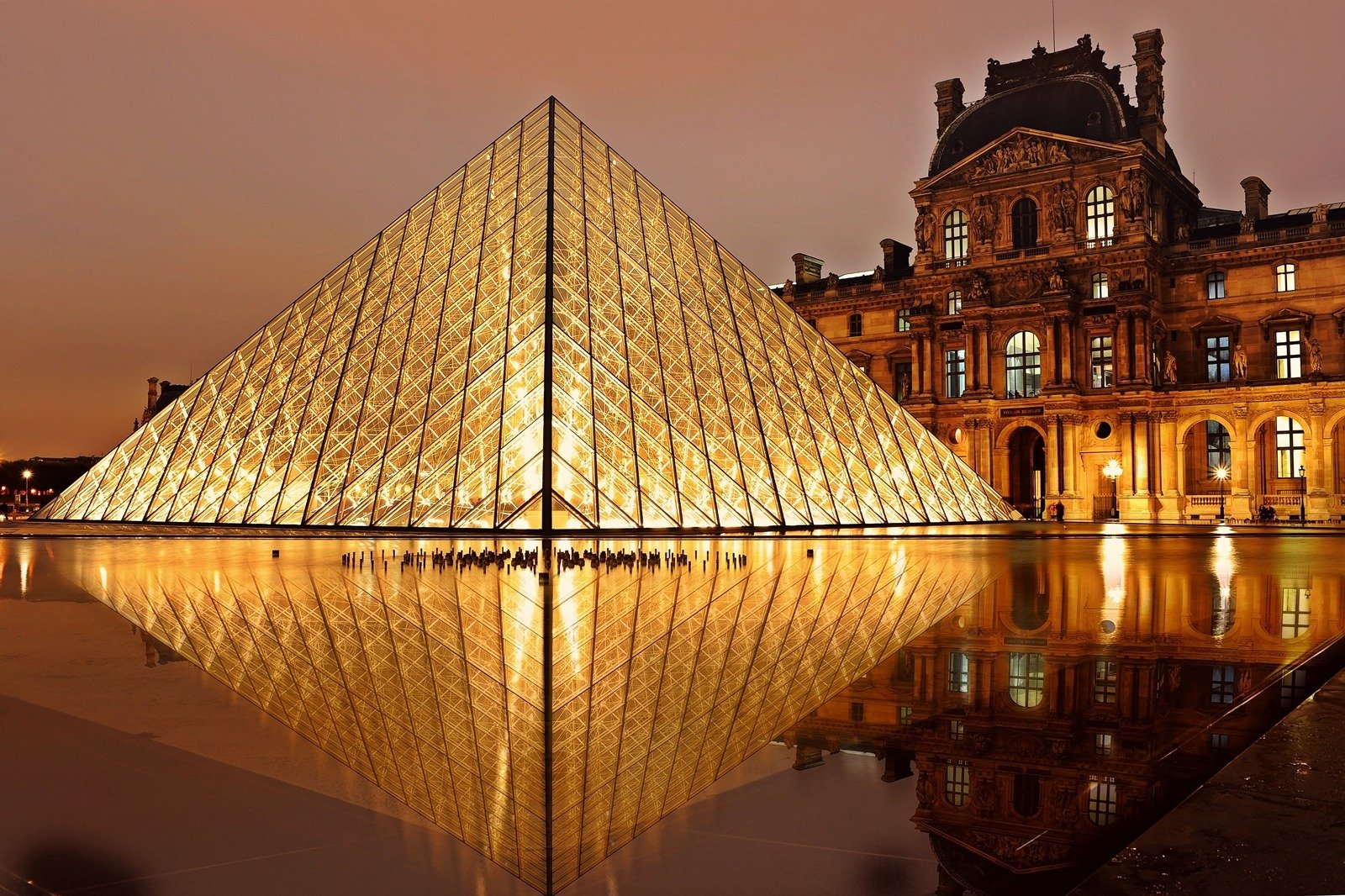
3. The Louvre Pyramid at Night: Why You Should Ignore the Museum
The Louvre itself is a museum. The pyramid outside is a photography studio. The glass reflects the surrounding palace, the city lights, and the sky. You don’t need a ticket.
The reflection trick
Bring a small puddle of water. Or, more practically, wait for rain. The courtyard’s stone floor collects shallow puddles after 15 minutes of rain. Crouch down so the camera is 20cm above the puddle. The pyramid reflects upside-down in the water. Use a 24mm lens, aperture f/11, ISO 100. Focus on the reflection, not the pyramid itself. The resulting image looks like the pyramid is floating on a mirror.
No rain? Use a 500ml water bottle and pour a small pool yourself. Security won’t stop you. I’ve done it three times.
Blue hour timing
Arrive 30 minutes after sunset. The sky turns deep blue for exactly 18-22 minutes. The pyramid’s lights turn on at the same time. Use the app Sun Surveyor ($5.99, iOS/Android) to confirm exact blue hour windows. Set your camera to manual mode: f/11, 15-second exposure, ISO 100. The long exposure smooths out any moving people into ghost-like streaks. If you want completely empty frames, shoot 20 exposures and stack them in Photoshop using the ‘Median’ blend mode.
Gear required: A sturdy tripod. The Leofoto LS-224C ($179, carbon fiber, 1.2kg) is light enough for carry-on and stable enough for 30-second exposures. A remote shutter release ($12 on Amazon) prevents camera shake. Without it, your 15-second shot will blur from your finger pressing the button.
4. Rue de l’Université: The Eiffel Tower Shot That Isn’t a Cliché
This is the famous ‘Eiffel Tower framed by buildings’ shot you’ve seen on Instagram. It works because the street creates a natural corridor that points directly at the tower. But most people mess it up.
Exact position
Stand at the intersection of Rue de l’Université and Avenue de la Bourdonnais. You want the tower centered between the two rows of Haussmann buildings. Use a 70-200mm lens at 135mm. The compression makes the tower look larger relative to the buildings. Aperture f/8. Focus on the tower.
Critical detail: The street is one-way. Cars come from behind you. Wait for a gap in traffic. Shoot when a taxi passes — the yellow color adds a pop against the gray buildings. Or wait for a red bus. The contrast works.
When this shot fails
Midday sun creates a flare from the buildings’ glass windows. The tower becomes a silhouette against a blown-out sky. Shoot at golden hour (the hour before sunset) or at night. At night, the tower’s lights turn on every hour on the hour. The first flash of lights at 9:00 PM (summer) or 6:00 PM (winter) is the cleanest moment before the crowds gather.
Alternative angle: Walk 200 meters south to Rue Saint-Dominique. Same framing concept, but the buildings are slightly taller, creating a tighter frame. The tower feels more imposing.
5. The Passerelle Debilly Footbridge: A 2-Sentence Verdict
This is the best spot to photograph the Eiffel Tower from across the Seine without the crowds of Pont d’Iéna. Arrive 20 minutes before sunset. Set up on the bridge’s wooden deck, facing west. Use a 50mm lens at f/5.6. The bridge’s steel arches frame the tower in a perfect U-shape. That’s it. One shot. Leave before the light fades — the bridge gets packed with street performers and loud groups by 9:30 PM.
6. The Palais-Royal Columns: Why Black and White Beats Color Here
The Buren Columns in the Palais-Royal garden are 260 striped pillars of varying heights. They’re a modernist sculpture in an 18th-century courtyard. In color, the black-and-white stripes clash with the surrounding beige stone. Convert to black and white in post. The contrast between the stripes and the shadows becomes the entire composition.
How to shoot it
Use a 16-35mm lens at 16mm. Stand at the south end of the courtyard, facing north. The columns recede into the distance. Use a polarizing filter (like the B+W Circular Polarizer, $49, 77mm thread) to cut reflections from the wet stone after rain. Set aperture to f/11 for depth of field. Focus one-third into the scene (hyperfocal distance). Shutter speed 1/60s at ISO 400.
Failure mode: Shooting at noon. The sun creates harsh shadows that break up the columns’ vertical lines. Shoot on an overcast day. The flat light makes the stripes the only visual element. The image becomes a study in pattern and texture.
Alternative approach: Shoot only the top half of the columns. Crouch down and point the camera upward. The columns converge at the top, creating a triangular frame around the sky. Works best with a clear blue sky or dramatic clouds.
7. The Canal Saint-Martin at Dawn: The Quiet Paris
This is the Paris of locals, not tourists. The canal runs through the 10th arrondissement. At 6:30 AM, the only people are joggers and barge operators. The light comes from the east, hitting the metal footbridges and the plane trees along the water.
Exact shooting schedule
| Time | Location | Shot | Gear |
|---|---|---|---|
| 6:30 AM | Pont de la Grange aux Belles | Footbridge reflection in still water | 24-70mm, f/8, 1/125s |
| 7:00 AM | Quai de Valmy, north of Rue du Faubourg du Temple | Barge with morning mist on water | 70-200mm, f/4, 1/250s |
| 7:30 AM | Ecluse des Récollets (lock #1) | Lock gates with water cascade | 16-35mm, f/11, 1/30s (use tripod) |
| 8:00 AM | Rue Eugène Varlin bridge | Wrought-iron bridge detail against sky | 85mm, f/2.8, 1/500s |
What to avoid: The canal’s water is greenish-brown, not blue. Don’t try to color-correct it to turquoise in post. It looks fake. Embrace the green. It’s authentic to the neighborhood.
Gear note for dawn shoots: Bring a headlamp (Black Diamond Spot 400, $29.95). The canal has uneven cobblestones and no railings in some sections. I slipped at 6:45 AM in February. The only thing that saved my camera was the strap. A headlamp costs less than a replacement lens.
One Final Practical Note
Paris has a 10:00 PM to 7:00 AM quiet hours law. Street photography at night is legal, but using a tripod on the sidewalk can get you stopped by police. If you’re shooting on a pedestrian bridge or a wide sidewalk, you’re fine. If you set up in the middle of a narrow street like Rue de l’Université, expect a conversation. Be polite, show them your camera screen, and they’ll usually wave you on.
The best photography spots in Paris aren’t the ones with the most Instagram tags. They’re the ones where the light, the geometry, and the timing line up. Pont Alexandre III at sunset. Montmartre at 7:00 AM. The Louvre pyramid after rain. The canal at dawn. Go early. Stay late. Bring a tripod.